Pages

16.4.14

Levels of Organization of Matter

I have tried to make this overview as precise, brief and simple as possible, but at the same time interesting to everybody, no matter your scientific and general knowledge background. It definitely wasn't an easy balance. Since we're passing over practically every science out there, making no mistakes was completely unrealistic, so I had to fight the austere perfectionist inside me to give this a shot. You might find some things difficult or some things not quite correct. If you belong to the former, don't get disappointed, the point is not to understand everything, but rather to get an idea about the structure of the Cosmos and get stimulated to learn more about it. Lots of links will redirect you to Wikipedia articles where you can read more about the various concepts discussed and at the end of the article you can find pictures for every level. If you belong to the latter, forgive my mistakes and send me some feedback about how I can make this even better, keeping in mind that the purpose of this article is not to be published in a scientific magazine. Enjoy!

Overview
1. Subatomic particle
2. Atom
3. Molecule
  3.1 Macromolecule
  3.2 Organelle
  3.3 Cell
  3.4 Tissue
  3.5 Organ
  3.6 Organ system
  3.7 Organism
  3.8 Population
  3.9 Community
  3.10 Ecosystem
  3.11 Biosphere
4. Cosmic dust
5. Accretion
6. Celestial body
7. Star system
8. Star cluster
9. Galaxy
10. Galaxy cluster
11. Universe

Matter has self-assembling properties. Here we’ll discuss the levels of its organization from the subatomic particles to the universe, even though more will probably be discovered as science progresses. Life, expressed by the levels between the macromolecules and the biosphere, is a branch of the organization of matter, since it is not necessary for the formation of the following levels. Also, this is only how life the way we know it on Earth is organized. We don't know that this is the only way "life" can be formed, as we haven't encountered any other type of life either on or off our planet. In any case, for the greater part of the universe, where there is no life, we pass from molecules directly to cosmic dust.

Elementary subatomic particles are unknown to have substructure, thus unknown to be composed of other particles. All elementary particles are, depending on their spin, either fermions or bosons. Fermions are the matter (quarks and leptons) and antimatter (antiquarks and antileptons) particles. The electron is a lepton. Bosons are “force particles”, i.e. they mediate interactions among fermions. So, fermions could be considered the structural unit of matter, while bosons are the mediators of the fundamental forces of nature (gravitational, electromagnetic, strong nuclear, and weak nuclear) that affect matter.

1a. Elementary subatomic particles included in the Standard Model.
Source: Wikipedia, Elementary particle

Combinations of elementary particles form the composite particles. Protons and neutrons are composite particles, each of them formed by three quarks, and together they form the nuclei of atoms.

1b. A proton is a composite particle
consisting of two up and one down quarks.
Source: Wikipedia, Proton
2. Atom
The atom is consisted of the nucleus and the electrons that are distributed around it. Depending upon the number of protons of the nucleus, the atom belongs to a different chemical element. Every element has its own chemical properties, which dictate the way it interacts with the other elements.

2. An illustration of the Helium atom, depicting the nucleus (pink)
and the electron cloud distribution (black).
Source: Wikipedia, Atom

The interactions of atoms lead to the formation of chemical bonds among them and the creation of a molecule. Every molecule has its own chemical properties, that result from the atoms that form it and the type of bond that connects them. This combination leads to “emergent” properties that the atoms themselves, when unbound, do not necessarily exhibit.
Molecules made of two or more different elements are called chemical compounds. Compounds that consist of any elements but carbon are called inorganic, while those that contain carbon are called organic.

3. A water molecule is made of two hydrogen and one oxygen atoms.


On certain occasions, many similar or identical compounds, the monomers, form long chains, the polymers. Organic polymers are very big molecules that exhibit, in turn, new (bio)chemical properties, like storing of information and complex and highly selective catalytic function (enzymes). Being very big, they are vulnerable and quickly split to their components when they are free in the environment. However, when they are protected, say, by a double layer of lipids, such as a cell membrane, they can persist, interact and form life, they way we know it on our planet. The macromolecules on which life depends are carbohydrates, proteins, nucleic acids and lipids (lipids are not true macromolecules, but are basic to life and are often mentioned along with the others).

3.1. DNA (deoxyribonucleic acid) is a type a nucleic acid that encodes the genetic information for the development and functioning of all known living organisms and many viruses. Here is depicted the structure of the double helix of the DNA. On the right, you can see the four monomers of the DNA, T, A, C, G.
Source: Wikipedia, DNA

The organelle is an organized collection of macromolecules and inorganic molecules within the cell that performs certain specific functions. For example, the mitochondrion is an organelle that contains macromolecules of all types, with the basic function of producing energy.

3.2 Electron microscopy of two mitochondria from mammalian lung tissue.
Source: Wikipedia, Mitochondrion

3.3 Cell
The cell is a collection of organelles and inorganic molecules (water, sodium, potassium etc) and it is the structural unit of life. It's the smallest possible entity that presents the characteristics of life and, therefore, that can be considered “alive”. Some cells constitute an organism themselves (unicellular organisms), while others live in groups (multicellular organisms).

3.3. The basic components of an animal cell.
Source: Wikipedia, Cell (biology)

3.4 Tissue
In multicellular organisms, cells can differ from each other. A group of similar cells that execute the same functions constitutes a tissue. For example, muscle tissue comprises many similar cells, the muscle cells (or muscle fibres), which have the same characteristics, including the ability to contract. The other three basic tissue types are the nerve, the epithelial and the connective tissue.

3.4. The different types of the muscle tissue.
Source: Wikipedia, Muscle tissue

3.5 Organ
The organ is consisted of cells of different tissues organized so that they can perform a complex, higher biological function. The heart, for example, contains a connective tissue “skeleton” in the shape of four rings that the heart muscle fibers attach to. The latter form four cavities that are covered internally by epithelial tissue, the endocardium. Externally, the entire heart muscle is covered by a double-walled epithelial sac, the pericardium. Within the walls of the heart there is its electrical conduction system, consisted of specialized cells that behave as both muscle and nervous tissue, which regulates the contraction of the muscle fibers. Thus, the heart functions as a pump, propelling forward the blood that enters it.

3.5. The human heart.
Source: Wikipedia, Heart

It is a group of organs that performs an even more complex biological function. The heart, a network of arterial, venous and capillary vessels, and the blood compose the cardiovascular system, which aims at the exchange of substances between every part of the body and the environment.

3.6. The human circulatory system.
Source: Wikipedia, Circulatory system

The organism is an individual, contiguous living system. It can be either uni- or multicellular. On the occasion of complex life forms, the organism is a set of organ systems that cooperate for the formation of an autonomous life form.

3.7. All organisms are classified in groups (from domains to species) based on their evolutionary relationships. Here is a speculative phylogenetic tree of life of all existent organisms based on genetic analysis.  Bacteria and archea are all unicellular, while the eukaryotes range from unicellular (such as the protozoan amoebas) to multicellular (such as all the plants and animals, including humans).
Source: Wikipedia, Organism

A group of organisms that belong to the same species.

3.8. Map of population trends of jellyfish. Red: increase (high certainty),
yellow: increase (low certainty), green: stable/variable, blue: decrease, gray: no data.
Source: Wikipedia, Population dynamics

A group of interacting organisms of different species that share the same environment.

3.9. Predation is an interspecific interaction basic to community ecology.
Source: Wikipedia, Community (ecology)

3.10 Ecosystem
A community along with the inorganic matter (soil, water, air etc) of its environment.

3.10. Nitrogen cycling in an ecosystem, containing bacteria, fungi, plants,
plant eating animals, along with inorganic materials, such as air and soil.
Source: Wikipedia, Ecosystem

3.11 Biosphere
It’s the set of all the ecosystems of the Earth (or another populated planet). Therefore, it also represents the zone of life on Earth.
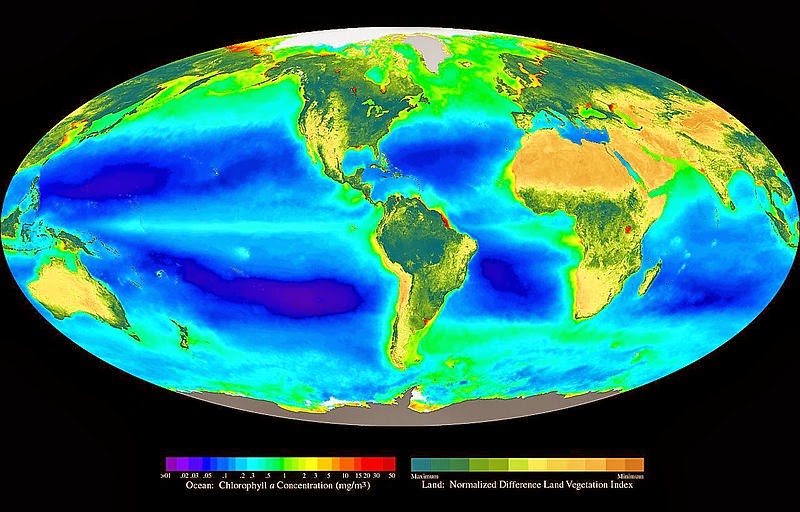
3.11. This composite image gives an indication of the magnitude and distribution
of global primary production (the production of organic matter
from inorganic carbon sources) both oceanic and terrestrial.
Source: Wikipedia, Biosphere

It is a small collection of molecules that floats into space.
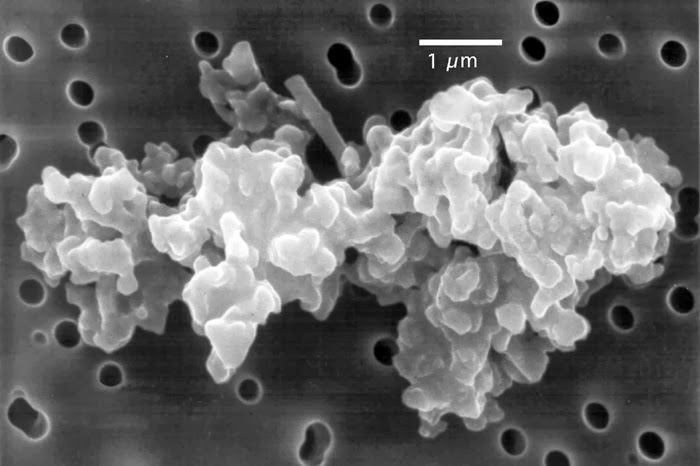
4. An interplanetary dust particle.
Source: Wikipedia, Cosmic dust

Dust particles, under the influence of gravity, attract each other and accumulate forming accretions.

5. Artist's conception of a black hole drawing matter
from a nearby star , forming an accretion disc.
Source: Wikipedia, Accretion disk

An accretion can be organized in a well formed celestial body. Stars are big spherical luminous celestial bodies, which produce their own light and heat. Planets are bodies that orbit a star and have enough mass so that they can obtain a spherical shape. They do not emit their own light and heat but receive these from their star. The planet we inhabit is the Earth and the star it orbits is the Sun. There are other celestial bodies, as well, such as asteroids and satellites.

6. Celestial bodies of our Solar System, including the Sun, the planets, asteroids etc.
Source: Wikipedia, Solar System model

It is consisted of a star along with the planets and the rest of the celestial bodies that are under the influence of its gravitational field. The star system of our Sun is called Solar system.

7. The orbits of the bodies in the Solar System to scale
(clockwise from top left)
Source: Wikipedia, Solarsystem

It is a group of stars, from tens to several millions, that are held together by the mutual gravitational forces. All the stars of a star cluster were born around the same period of time from the same cosmic dust.

8. The star cluster of Pleiades.
Source: Wikipedia, Star cluster

9. Galaxy
A system of millions or billions of star systems and clusters that are held together by gravitational forces forms a galaxy. The galaxy in which our solar system is found is the Milky way.

9. A fish-eye mosaic of the Milky Way arching at a high inclination across the night sky,
shot from a dark sky location in Chile.
Source: Wikipedia, Milky Way

A group of galaxies (from a few to a few thousands) that are held together by gravity comprise a galaxy cluster.

10. The Abell S740 galaxy cluster.
Source: Wikipedia, Abell_S740

All of the existent spacetime, along with all of the matter and energy that it contains, constitute the Universe.

11. Illustration of the Big bang theory, the prevailing cosmological model. In this diagram time increases from left to right, and one dimension of space is suppressed, so at any given time the Universe is represented by a disk-shaped "slice" of the diagram.
Source: Wikipedia, Universe

Explore the various levels in this wonderful interactive animation: The Scale of the Universe

29.3.14

Why? What is the Reason? What is the Purpose?


“Why” is the question word that asks for the “reason” behind things. However, “reason” can mean both the cause that leads to a specific outcome (Why do objects fall? Because gravity pulls them towards the earth) and the purpose behind a specific outcome that will be fulfilled after its realization (Why did you turn on the oven? Because I want to bake something).

Living organisms seem (to humans) to cause certain outcomes for a “purpose”: They move in order to find food or escape a hunter. They use special signals in order to attract the opposite sex. As they grow, they learn how certain actions lead to certain outcomes and then they do these actions with the purpose of bringing this outcome.

Bacteria phagocytosed by an amoeba 
Source
Humans seem (to humans) to do everything with a “purpose”. They have taught themselves how to manipulate all sorts of forces around them. They put seeds in the ground and take care of the plants that grow and then harvest them, instead of looking for plants planted by “chance”, therefore that need to be stumbled upon by “chance”. They build complex structures that can explore the deep oceans, or the deep space.

But there is no “purpose” in the lightning bolt that hits the tallest tree of an area. That’s how lightning bolts are, how they work. The physics behind it dictate that the lightning bolt is created between certain regions of a cloud and of the ground that are oppositely charged. Most often, the tallest mass of the area of the ground is the one that gets hit. Clearly, there’s nothing “personal”. The lightning bolt doesn’t “choose” which tree to hit and doesn’t hit a certain tree “for a reason”.

So, the “lifeless” part of the universe doesn’t exhibit any form of “purpose”. Years and years of science show that the better we understand the world around us the better our predictions about its interactions become. And whenever something “unexplainable” by the current standards comes along, it’s just explained by a few new ideas that we hadn’t come up with until that point.

Our everyday lives haven’t really involved rain chasing a specific person or any lifeless object, defying the rules of physics for some “purpose”. We’ve dropped countless objects and yet not one has hovered to our surprise (magic tricks are only tricks on perception). The driver and the mechanics lead a car. If one “loses” control of a car, the car isn’t acting “for a purpose”.

There is “purpose” in that car accident only if someone involved acted specifically in that way with the intention to bring it about. There is something to be said about the conscious and the subconscious, but that still doesn’t bring in some higher, deeper purpose in the equation.

However, purpose, even when it comes to living creatures, is simply the rationalization our brain has created to fill in the blanks of causality. Observing a human reach for a glass of water, we might argue that the “reason”, with the meaning of “purpose”, of this action is “to drink water”. However, this simply skips the true reason, with the meaning of “cause” this time, for the action: which is, most probably, that the human is thirsty. Therefore, we have very good reasons to think “purpose”, and “reason” when it is implying “purpose”, is simply a biocentristic idea, that has evolved in the brains of a type of conscious creature, floating on a rock in the deep, cold space, otherwise devoid of any teleological “purpose”.

The pale blue dot.

10.3.14

The Apple Tree


Three friends are walking in the countryside. As they are approaching a big, beautiful apple tree, an apple suddenly falls from a branch to the grassy ground. They stop to look at it and one of them sighs:

“How I would like to know why the apple fell!”
The second friend picks up the apple, takes a bite, and shakes her head in appreciation:
“I’m more impressed by its taste. I want to know why it tastes like that!”
But the third one is already eyeing the tree with interest and adds thoughtfully:
“I am wondering how the apple came from the tree.”

Out of nowhere, a bunch of kids appears and, laughing and running, they cry out: “We want to know how many apples are on this apple tree!” and with lots of pushing and tagging they scramble up its bark, scatter on the branches, and start counting loudly. The friends laugh and then fall in silent contemplation. Each one observes, gropes the ground, the tree, the apple. Every now and then they exchange opinions, ask each other for new ideas, seek validation for their conclusions. Indeed, they all have useful things to say about everything, though, of course, each is more dedicated to their own quest. Occasionally, they look up and ask the kids, which keep on their merry and noisy counting, to confirm their theories.

After some time, they’ve all satisfied their curiosity. The one friend knows why the apple fell. The other has found why it tastes the way it tastes. The last one understands how the apple came to be. And the kids have counted the apples. And after a few more apple-bites under the shadow of the patient apple tree, they all continue their walk. And it’s time I introduced them to you:

The first friend is Physics.

The second is Chemistry.

The third is Biology.

And the kids… are Mathematics!

27.2.14

Τα επίπεδα οργάνωσης της ύλης

Προσπάθησα να κάνω αυτήν την περίληψη όσο πιο ακριβή, σύντομη και απλή γίνεται, αλλά ταυτόχρονα ενδιαφέρουσα σε όλους, ανεξαρτήτως του υποβάθρου σας στην επιστήμη και σε γενικές γνώσεις. Δεν ήταν καθόλου εύκολη ισορροπία. Καθώς περνάμε, στην ουσία, από όλες τις επιστήμες που υπάρχουν, ήταν τελείως απίθανο να μην γίνουν λάθη, οπότε έπρεπε να καταπολεμήσω την αυστηρή τελειομανή μέσα μου για να επιχειρήσω κάτι τέτοιο. Μπορεί να βρείτε ορισμένα πράγματα δύσκολα ή όχι εντελώς σωστά. Στην πρώτη περίπτωση, μην απογοητευτείτε, το νόημα δεν είναι να καταλάβετε τα πάντα, αλλά να πάρετε μια ιδέα για την δομή του Σύμπαντος και να κινητοποιηθείτε για να μάθετε περισσότερα. Πολλοί σύνδεσμοι θα σας παραπέμψουν σε άρθρα της Βικιπαίδειας, όπου μπορείτε να διαβάσετε περισσότερα για τις διάφορες έννοιες υπό συζήτηση και στο τέλος του άρθρου θα βρείτε εικόνες για κάθε επίπεδο. Στην δεύτερη περίπτωση, συγχωρέστε τα λάθη μου και στείλ’τε μου τις απόψεις σας για το πώς μπορώ να κάνω την συλλογή αυτή ακόμα καλύτερη, έχοντας στο μυαλό σας ότι ο σκοπός αυτού του άρθρου δεν είναι να εκδοθεί σε επιστημονικό περιοδικό.

Η ύλη έχει ικανότητες αυτοοργάνωσης. Εδώ θα αναφερθούμε στα επίπεδα οργάνωσής της από τα υποατομικά σωματίδια μέχρι το σύμπαν, παρ’ όλο που είναι πιθανό να ανακαλυφθούν και άλλα με την ανάπτυξη της επιστήμης. Η ζωή, που εκφράζεται από τα επίπεδα μεταξύ μεγαλομορίων και βιόσφαιρας, αποτελεί παρακλάδι στην οργάνωση της ύλης, αφού δεν είναι απαραίτητη για τον σχηματισμό των επόμενων επιπέδων. Επιπλέον, η ζωή είναι οργανωμένη με αυτόν τον τρόπο μόνο όπως την γνωρίζουμε στην Γη. Δεν γνωρίζουμε αν αυτός είναι ο μόνος τρόπος που μπορεί να σχηματιστεί η «ζωή», καθώς δεν έχουμε συναντήσει άλλο είδος ζωής πάνω στον πλανήτη μας ή έξω από αυτόν. Σε κάθε περίπτωση, στο μεγαλύτερο μέρος του σύμπαντος, όπου δεν υπάρχει ζωή, περνάμε κατευθείαν από τα μόρια στην κοσμική σκόνη.

Τα στοιχειώδη υποατομικά σωματίδια δεν έχουν γνωστή εσωτερική δομή, δηλαδή μέχρι στιγμής δεν γνωρίζουμε να αποτελούνται από μικρότερα σωματίδια. Όλα τα στοιχειώδη σωματίδια είναι, αναλόγως την ιδιοπεριστροφή τους, φερμιόνια ή μποζόνια. Τα φερμιόνια αποτελούν τα σωματίδια που σχηματίζουν την ύλη (κουάρκ και λεπτόνια) και την αντιύλη (αντικουάρκ και αντιλεπτόνια). Το ηλεκτρόνιο είναι ένα λεπτόνιο. Τα μποζόνια είναι τα σωματίδια των δυνάμεων, δηλαδή μεσολαβούν στις αλληλεπιδράσεις μεταξύ των φερμιονίων. Επομένως, τα φερμιόνια μπορούν να θεωρηθούν ως η δομική μονάδα της ύλης, ενώ τα μποζόνια ως οι μεσολαβητές των θεμελιωδών δυνάμεων της φύσης (βαρυτική, ηλεκτρομαγνητική, ισχυρή πυρηνική και ασθενής πυρηνική) που επηρεάζουν την ύλη.
Συνδυασμοί των στοιχειωδών υποατομικών σωματιδίων σχηματίζουν τα σύνθετα σωματίδια. Τα πρωτόνια και τα νετρόνια καθένα από τα οποία σχηματίζονται από τρια κουάρκ το καθένα και μαζί συνθέτουν τον πυρήνα του ατόμου.

Το άτομο αποτελείται από τον πυρήνα και τα ηλεκτρόνια που κατανέμονται γύρω από αυτόν. Ανάλογα με τον αριθμό νετρονίων και πρωτονίων του πυρήνα, το άτομο ανήκει σε διαφορετικό χημικό στοιχείο. Κάθε χημικό στοιχείο έχει τις δικές του χημικές ιδιότητες, οι οποίες καθορίζουν τον τρόπο με τον οποίο αλληλεπιδρά με τα άλλα χημικά στοιχεία.

Οι αλληλεπιδράσεις μεταξύ ατόμων οδηγούν στο σχηματισμό χημικών δεσμών μεταξύ τους και στη δημιουργία ενός μορίου. Κάθε μόριο έχει κι αυτό τις δικές του χημικές ιδιότητες, που προκύπτουν από τα άτομα που το αποτελούν και τον τύπο του δεσμού που τα συνδέει. Ο συνδυασμός αυτός οδηγεί σε «αναδυόμενες» ιδιότητες τις οποίες δεν έχουν απαραίτητα τα επιμέρους άτομα όταν είναι αδέσμευτα.
Μόρια που σχηματίζονται από δύο ή περισσότερα διαφορετικά στοιχεία ονομάζονται χημικές ενώσεις. Χημικές ενώσεις που αποτελούνται από οποιαδήποτε άλλα στοιχεία εκτός του άνθρακα ονομάζονται ανόργανες, ενώ αυτές που περιέχουν άνθρακα ονομάζονται οργανικές.
Σε ορισμένες περιπτώσεις, πολλές παρόμοιες ή ίδιες ενώσεις, που ονομάζονται μονομερή, σχηματίζουν μεγάλες αλυσίδες, τα πολυμερή. Τα οργανικά πολυμερή είναι πολύ μεγάλα μόρια που εμφανίζουν με τη σειρά τους ορισμένες νέες (βιο)χημικές ιδιότητες, όπως είναι η αποθήκευση πληροφορίας και η περίπλοκη και ειδική καταλυτική λειτουργία (ένζυμα). Τα μόρια αυτά, επειδή είναι πολύ μεγάλα, είναι και πολύ ευαίσθητα και δύσκολα επιβιώνουν ελεύθερα στο περιβάλλον. Διασπώνται γρήγορα στα επιμέρους συστατικά τους. Ωστόσο, όταν είναι προστατευμένα, όπως, ας πούμε, με μία διπλή στιβάδα λιπιδίων, την κυτταρική μεμβράνη, διατηρούνται και τους δίνεται η δυνατότητα να αλληλεπιδράσουν και να σχηματίσουν ζωή, όπως την γνωρίζουμε στον πλανήτη μας. Τα μακρομόρια στα οποία βασίζεται η ζωή είναι οι υδατάνθρακες, οι πρωτεΐνες, τα νουκλεϊκά οξέα και τα λιπίδια (τα λιπίδια δεν είναι αληθινά πολυμερή, αλλά είναι βασικά για την ζωή και συχνά αναφέρονται μαζί με τα υπόλοιπα).
Το οργανίδιο είναι μία οργανωμένη συλλογή μακρομορίων αλλά και ανόργανων ενώσεων μέσα στο κύτταρο που εκτελεί κάποιες ειδικές λειτουργίες. Για παράδειγμα, το μιτοχόνδριο είναι ένα οργανίδιο που περιέχει διάφορα μακρομόρια όλων των κατηγοριών και η βασική του λειτουργία είναι η παραγωγή ενέργειας.
Το κύτταρο είναι μία συλλογή οργανιδίων και ανόργανων μορίων (νερό, νάτριο, κάλιο κλπ) και είναι η δομική μονάδα της ζωής. Είναι, δηλαδή, η μικρότερη δυνατή οντότητα που παρουσιάζει τους χαρακτήρες της ζωής και άρα που μπορεί να θεωρηθεί «ζωντανή». Ορισμένα κύτταρα αποτελούν από μόνα τους έναν οργανισμό (μονοκύτταροι οργανισμοί), ενώ άλλα συνθέτουν συναφείς ομάδες (πολυκύτταροι οργανισμοί).
Στους πολυκύτταρους οργανισμούς, τα κύτταρα μπορεί να διαφέρουν μεταξύ τους. Μία ομάδα όμοιων κυττάρων που εκτελεί συγκεκριμένες λειτουργίες αποτελεί ένα ιστό. Για παράδειγμα, ο μυϊκός ιστός αποτελείται από πολλά όμοια κύτταρα, τα μυϊκά κύτταρα (ή μυϊκές ίνες), τα οποία έχουν τα ίδια χαρακτηριστικά, συμπεριλαμβανομένης της ικανότητας να συστέλλονται. Άλλοι ιστοί είναι ο νευρικός, ο επιθηλιακός και ο στηρικτικός ιστός.
Ένα όργανο αποτελείται από κύτταρα διαφορετικών ιστών, οργανωμένα έτσι ώστε να εκτελούν μία σύνθετη, ανώτερη βιολογική λειτουργία. Η καρδιά, για παράδειγμα, αποτελείται από έναν «σκελετό» στηρικτικού ιστού σε σχήμα τεσσάρων δακτυλίων, στους οποίους προσφύονται οι καρδιακές μυϊκές ίνες. Αυτές σχηματίζουν τέσσερις κοιλότητες που εσωτερικά καλύπτονται από ειδικό επιθηλιακό ιστό, το ενδοκάρδιο. Εξωτερικά, όλος ο μυς της καρδιάς καλύπτεται από ένα διπέταλο επιθηλιακό σάκο, το περικάρδιο. Μέσα στα τοιχώματα της καρδιάς βρίσκεται ένα σύστημα ηλεκτρικής αγωγιμότητας που συνίσταται από εξειδικευμένα κύτταρα με χαρακτηριστικά τόσο μυϊκού όσο και νευρικού ιστού, το οποίο ρυθμίζει τη συστολή των μυϊκών ινών. Η καρδιά, έτσι, λειτουργεί ως αντλία προωθώντας το αίμα που εισέρχεται σε αυτή.
Είναι μια ομάδα οργάνων που εκτελεί μία ακόμη πιο σύνθετη βιολογική λειτουργία. Η καρδιά, ένα δίκτυο αρτηριών, φλεβών και τριχοειδών αγγείων, και το αίμα συνθέτουν το καρδιαγγειακό σύστημα, το οποίο έχει σκοπό την ανταλλαγή ουσιών μεταξύ κάθε σημείου του σώματος και του περιβάλλοντος.  
Ο οργανισμός είναι μία ξεχωριστή, συναφής μορφή ζωής. Μπορεί να είναι είτε μονοκύτταρος είτε πολυκύτταρος. Στην περίπτωση σύνθετων μορφών ζωής, ο οργανισμός είναι ένα σύνολο οργανικών συστημάτων που συνεργάζονται προς  το σχηματισμό μιας αυτόνομης μορφής ζωής.
Πληθυσμός είναι μία ομάδα οργανισμών που ανήκουν στο ίδιο είδος.
Κοινότητα είναι μια ομάδα αλληλεπιδρώντων οργανισμών που ανήκουν σε διαφορετικά είδη και μοιράζονται την ίδια περιοχή.
Οικοσύστημα είναι μία κοινότητα μαζί με την άβια ύλη (γη, νερό, αέρας κλπ) εντός της περιοχής.
Είναι το σύνολο όλων των οικοσυστημάτων της Γης (ή άλλου κατοικημένου πλανήτη). Επομένως, αντιπροσωπεύει επίσης την ζώνη της Γης που φιλοξενεί τη ζωή.
Είναι μικρές συλλογές μορίων που αιωρούνται στο διάστημα.

Σωματίδια σκόνης κάτω από την επίδραση της βαρύτητας έλκονται και συσσωρεύονται σχηματίζοντας συσσωματώσεις ύλης.

Μία συσσωμάτωση της ύλης μπορεί να οργανωθεί σε ένα καλά σχηματισμένο ουράνιο σώμα. Τα άστρα είναι μεγάλα σφαιρικά ουράνια σώματα που είναι αυτόφωτα, δηλαδή παράγουν δικό τους φως και δική τους θερμότητα. Οι πλανήτες είναι σώματα που περιφέρονται γύρω από ένα άστρο και έχουν αρκετή μάζα ώστε να αποκτήσουν σφαιρικό σχήμα. Είναι ετερόφωτοι, δηλαδή δεν παράγουν φως και θερμότητα, παρά μόνο τα δέχονται από το άστρο τους. Ο πλανήτης που κατοικούμε είναι η Γη και το άστρο γύρω από το οποίο περιφέρεται είναι ο Ήλιος. Υπάρχουν και άλλα ουράνια σώματα, όπως οι αστεροειδείς και οι δορυφόροι.

Αποτελείται από ένα άστρο μαζί με τους πλανήτες και τα λοιπά ουράνια σώματα που βρίσκονται υπό την επίδραση του βαρυτικού του πεδίου. Το αστρικό σύστημα του Ήλιου μας ονομάζεται Ηλιακό σύστημα.

Είναι μία ομάδα άστρων, από δεκάδες μέχρι μερικά εκατομμύρια, που συγκρατώνται μεταξύ τους λόγω των αμοιβαίων βαρυτικών έλξεων. Όλα τα άστρα ενός αστρικού σμήνους γεννήθηκαν την ίδια περίοδο από την ίδια αστρική σκόνη και το καθένα έχει το δικό του αστρικό σύστημα, με τους πλανήτες, τους αστεροειδείς του κλπ

Ένα σύστημα εκατομμυρίων ή δισεκατομμυρίων αστρικών συστημάτων και σμηνών που συγκρατούνται μεταξύ τους μέσω βαρυτικών δυνάμεων καλείται γαλαξίας. Ο Γαλαξίας στον οποίο ανήκει το ηλιακό μας σύστημα γράφεται με κεφαλαίο, καθώς θεωρείται κύριο όνομα.

Μία ομάδα γαλαξιών (από μερικούς μέχρι χιλιάδες στον αριθμό) που συγκρατούνται μεταξύ τους μέσω της βαρύτητας αποτελούν ένα σύμπλεγμα γαλαξιών.

Όλος ο υπάρχων χωροχρόνος, μαζί με όλη την ύλη και ενέργεια που περιλαμβάνει, αποτελεί το Σύμπαν.

Περιηγηθείτε στα διάφορα επίπεδα με αυτήν την υπέροχη διαδραστική απεικόνιση: Η κλίμακα του σύμπαντος

1α. Τα στοιχειώδη υποατομικά σωματίδια που περιλαμβάνονται
στο Καθιερωμένο Πρότυπο.
Πηγή: Wikipedia, Elementary particle
1β. Το πρωτόνιο είναι σύνθετο σωματίδιο που αποτελείται
από δύο «πάνω» και ένα «κάτω» κουάρκ
Πηγή: Wikipedia, Proton
2. Αναπαράσταση του ατόμου του Ηλίου, όπου απεικονίζεται
ο πυρήνας (ροζ) και το ηλεκτρονιακό νέφος (μαύρο-γκρι)
Πηγή: Wikipedia, Atom
3. Ένα μόριο νερού αποτελείται από δύο άτομα υδρογόνου και ένα οξυγόνου.
3.1. Το DNA (δεοξυριβονουκλεϊκό οξύ) είναι ένα είδος νουκλεϊκού οξέος που κωδικοποιεί την γενετικές πληροφορίες για την ανάπτυξη και λειτουργία όλων των γνωστών ζωντανών οργανισμών και πολλών ιών. Εδώ απεικονίζεται η δομή της διπλής έλικας του DNA. Δεξιά, μπορείτε να δείτε τα τέσσερα μονομερή του DNA, T, A, C, G.
Πηγή: Wikipedia, DNA
3.2 Ηλεκτρονική μικροσκόπηση δύο μιτοχονδρίων από πνευμονικό ιστό θηλαστικού.
Πηγή: Wikipedia, Mitochondrion
3.3. Τα βασικά συστατικά ενός ζωϊκού κυττάρου.
Πηγή: Wikipedia, Cell (biology)
3.4. Τα διαφορετικά είδη μυϊκού ιστού.
Πηγή: Wikipedia, Muscle tissue
3.5. Η ανθρώπινη καρδιά.
Πηγή: Wikipedia, Heart
3.6. Το ανθρώπινο κυκλοφορικό σύστημα.
Πηγή: Wikipedia, Circulatory system
3.7. Όλοι οι οργανισμοί ταξινομούνται σε ομάδες (από επικράτειες μέχρι σε είδη) με βάση την εξελικτική τους σχέση. Αυτό είναι ένα υποθετικό φυλογενετικό δέντρο της ζωής όλων των υπάρχοντων οργανισμών βάσει γενετικής ανάλυσης. Τα βακτήρια και τα αρχαία είναι όλα μονοκύττρα, ενώ οι ευκαρυωτικοί κυμαίνονται από μονοκύτταροι (όπως είναι τα πρωτόζωα αμοιβάδες) ως πολυκύτταροι (όπως είναι όλα τα φυτά και τα ζώα, συμπεριλαμβανομένου και του ανθρώπου).
Πηγή: Wikipedia, Organism
3.8. Χάρτης της τάσης του πληθυσμού των  τσουχτρών. Κόκκινο: αύξηση (υψηλή βεβαιότητα),
κίτρινο: αύξηση (χαμηλή βεβαιότητα), πράσινο: σταθερός/κυμαινόμενος, μπλε: ελάττωση, γκρι: έλλειψη δεδομένων.
Πηγή: Wikipedia, Population dynamics
3.9. Η θήρευση είναι μία βασική διαειδική αλληλεπίδραση στην οικολογία μιας κοινότητας.
Πηγή: Wikipedia, Community (ecology)
3.10. Ο κύκλος του αζώτου σε ένα οικοσύστημα που περιλαμβάνει βακτήρια, μήκυτες, φυτά, φυτοφάγα ζώα μαζί με ανόργανα υλικά όπως αέρα και χώμα.
Πηγή: Wikipedia, Ecosystem
3.11. Αυτή η εικόνα δείχνει το μέγεθος και την κατανομή της παγκόσμιας πρωτογενούς παραγωγής (της παραγωγής οργανικής ύλης από ανόργανες πηγές άνθρακα), τόσο στους ωκεανούς όσο και στη στεριά.
Πηγή: Wikipedia, Biosphere
4. Ένα σωματίδιο διαπλανητικής σκόνης.
Πηγή: Wikipedia, Cosmic dust
5. Καλλιτεχνική σύλληψη μιας μαύρης τρύπας που έλκει ύλη από ένα κοντινό άστρο,
με αποτέλεσμα τον σχηματισμό ενός δίσκου επαύξησης.
Πηγή: Wikipedia, Accretion disk
6. Τα ουράνια σώματα του Ηλιακού μας Συστήματος, συμπεριλαμβανομένου
του Ήλιου, των πλανητών, των αστεροειδών κλπ.
Πηγή: Wikipedia, Solar System model
7. Οι τροχιές των σωμάτων του Ηλιακού Συστήματος σε κλίμακα
(με την κατεύθυνση του ρολογιού από πάνω αριστερά)
Πηγή: Wikipedia, Solarsystem
8. Το αστρικό σμήνος των Πλειάδων.
Πηγή: Wikipedia, Star cluster
9. Μωσαϊκό με την φωτογραφική τεχνική «μάτι του ψαριου» του Γαλαξία
να σχηματίζει αψίδα στον νυχτερινό ουρανό. Λήψη από σκοτεινό μέρος στην Χιλή.
Πηγή: Wikipedia, Milky Way
10. Το σμήνος γαλαξιών Abell S740.
Πηγή: Wikipedia, Abell_S740
11. Απεικόνιση της Θεωρίας της Μεγάλης Έκρηξης, που είναι το επικρατούν κοσμολογικό μοντέλο. Στο διάγραμμα αυτό ο χρόνος αυξάνεται από αριστερά προς τα δεξιά και μία διάσταση του χώρου έχει συμπιεστεί, έτσι ώστε σε κάθε δεδομένη χρονική στιγμή το Σύμπαν να αντιπροσωπεύεται από μία τομή σε σχήμα δίσκου.
Πηγή: Wikipedia, Universe

9.2.14

Why Sam Harris shouldn’t change his mind

(if all arguments are as bad as Jonathan Haidt's)

There is an ongoing war in Philosophy, in case you haven’t noticed: Realism vs Relativism. Is there an objective reality? Or is the universe –or multiverse– inseparable from the subjectivity of the human mind? An especially fierce part of this war is fought in the realm of Moral Philosophy: Moral Realism or Moral Relativism? Is morality objective or subjective?

Most people who agree with the former, only do so because they believe the source of their morality is some supernatural entity. Most secularists, and even otherwise “realists”, on the other hand, claim that morality has no basis in nature, and therefore is an entirely human construct, devoid of any “objectivity”.

Much recent work in science and philosophy has shaken that widely-held belief. Even though making the case for moral realism per se isn't the purpose of this essay, I'll mention some examples, and you can read more about them yourselves, if you'd like. Dutch primatologist and ethologist Frans de Waal has showed with a life-long career in research that proto-morality, basic empathy and reciprocity, exist in other mammals, and especially so in primates (Frans de waal: Moral behavior in animals). This suggests that morality is simply an emergent phenomenon, naturally selected for and brought about by evolution. (Ironically, however, Frans seems to agree with Haidt’s most recent article).

Harvard University psychologist Steven Pinker in his book “The Better Angels of our Nature” argues that violence has been decreasing throughout human history and considers it unlikely that the explanation lies in changes in human nature. As many other factors of human experience remain unchanged, it’s more likely that human nature is simply characterized both by inclinations toward violence and those that counteract them; and the latter seem to be slowly but surely prevailing (Steven Pinker: The surprising decline in violence). Aren't societies slowly but surely converging towards the same core moral values of peace, equality and fairness?

I'm painfully aware that it was simple chance
I was born in a place and time where my basic
human rights were more or less protected
It could be said, as this is being composed by a strictly middle class, young, Greek, female citizen, literate enough to know how to write, educated enough so she can understand the topic under discussion, “wealthy” enough to own a netbook and an internet access, and free enough to express her opinion, that we’ve come a long way in terms of human rights, which are, of course, closely related to morality. Just a few decades ago (or a few hundred kilometers away) she would be unable or forbidden to participate. Are those "human rights" just a matter of personal taste? 

But maybe the boldest of moves on this war-field has been made by philosopher and neuroscientist Sam Harris. In his book, “The Moral Landscape”, he makes the most comprehensive and concise case of moral realism as of yet: One need only accept that morality has to do with the well-being of conscious creatures. Then, if we imagine a situation where all conscious beings are suffering as much as they can for as long as they can, this is, by default, the worst possible world to live in. Anything else is, by default, better. This immediately shows that there can be objectively better and worse situations to be in, and therefore there can be objectively better or worse answers to moral questions. There are lots of details to be discussed, but the essence is that morality is, at least in principle if not also in practice, objective (Sam Harris: Science can answer moral questions).

My point is not to support Harris’ claim. I do happen to agree with it (and disagree with several of his other positions, by the way), but that hasn’t prevented me from really trying to find a good counter-argument. Exactly because I prefer the idea that morality is objective, I want the disproof presented to me sooner rather than later. Not only have I failed, but any kind of criticism I’ve heard or read keeps repeating the same four or five straw-men, red-herring etc arguments, to my -and apparently Harris’, as well- disappointment. A few months ago, that led Harris to announce “The Moral Landscape Challenge”, challenging anyone to prove that his core argument about moral realism is flawed, for the not-so-modest prize of $10.000.

In an essay, Why Sam Harris is Unlikely to Change his Mind, social psychologist Jonathan Haidt, writer of “The Righteous Mind” and a moral relativist, counters the bet: “The Righteous Mind challenge: If anyone can convince Harris to renounce his views, I’ll pay Harris the $10,000 that it would cost him to do so.”

Just a friendly piece of advice: If anyone is serious about “changing Harris’ mind”, they’d better do a much better job than Haidt does.

In the above essay, Haidt argues that “[...] science has a long track record of undermining claims about God’s role in the material world”, but it has also “undermined claims about the role and reliability of reason in our daily lives”. He goes on to list some of the human cognitive biases science has exposed, one of which is the emotional attachment to ideas; not wanting to change our minds. So his claim is that science, by exposing our biases, has undermined the role and reliability of reason itself. Isn't that just word-play? He's just embedding in the definition of the term “reason” the quality of its application. Reason can be applied correctly or falsely. That is not a short-coming of reason itself. You can use any tool in a wrong way. You can try to wash clothes in a dish washer, you can try to lock a door with a nail polisher. It's not the tool that's failing when you are not using it as you're supposed to. Would we have ever gotten to expose some of our biases if reason was not capable of overcoming them in the first place?

Later on, Haidt confuses us even more by saying: “Reason is indeed crucial for good public policy and a good society. But isn’t the most reasonable approach one that takes seriously the known flaws of human reasoning and tries to work around them?” What does that even mean? Again, it's just word-play. How do we “take seriously the known flaws of human reasoning” if not by using more, better reasoning? Is there any other way of exposing biases than through reasoning? Horoscopes? Gods? Hunches?

Let's ignore that little bit of weird reasoning about reasoning. He goes on: “If reasoning is so easily swayed by passions, then what kind of reasoning should we expect from people who hate religion and love reason? Open-minded, scientific thinking that tries to weigh the evidence on all sides? Or standard lawyerly reasoning that strives to reach a pre-ordained conclusion? When I was doing the research for The Righteous Mind, I read the New Atheist books carefully, and I noticed that several of them sounded angry. I also noticed that they used rhetorical structures suggesting certainty far more often than I was used to in scientific writing – words such as “always” and “never,” as well as phrases such as “there is no doubt that…” and “clearly we must…””

Well, for one thing, these books are not strictly speaking scientific, as they are directed to the general public, but let’s ignore that, too. Notice the two claims Haidt is making in one breath:
a) Using more “rhetorical structures suggesting certainty” means you, personally, are more certain, and
b) Being more certain than someone else is evidence against “open-minded, scientific thinking that tries to weigh the evidence on all sides”, and for “standard lawyerly reasoning that strives to reach a pre-ordained conclusion”.
He doesn't say how he knows this, he simply accepts it as a given (to reach his pre-ordained conclusions?). And, then he claims to have proven it, by following this highly scientific “methodology”.

He basically ran the texts of a few books through a text analysis software program, the Linguistic Inquiry and Word Count, outputting the "Certain category" which contained the following words and word stems:
“absolute, absolutely, accura*, all, altogether, always, apparent, assur*, blatant*, certain*, clear, clearly, commit, commitment*, commits, committ*, complete, completed, completely, completes, confidence, confident, confidently, correct*, defined, definite, definitely, definitive*, directly, distinct*, entire*, essential, ever, every, everybod*, everything*, evident*, exact*, explicit*, extremely, fact, facts, factual*, forever, frankly, fundamental, fundamentalis*, fundamentally, fundamentals, guarant*, implicit*, indeed, inevitab*, infallib*, invariab*, irrefu*, must, mustnt, must’nt, mustn’t, mustve, must’ve, necessar*, never, obvious*, perfect*, positiv*, precis*, proof, prove*, pure*, sure*, total, totally, true, truest, truly, truth*, unambigu*, undeniab*, undoubt*, unquestion*, wholly”
And the results showed that “the New Atheists win the "certainty" competition”. And that means that “Sam Harris is unlikely to change his mind”. Lots and lots of claims, little, if any, evidence.

Now, as a good skeptic, I did my research, read the information on the LIWC site, and even took the liberty of contacting them for further information, just in case I was missing something, as neither English is my native language nor text analysis my field. Roger Booth was kind enough to respond to me:
“LIWC only claims to report the proportion of words in various categories. Beyond that it’s up to the person using the analysis to interpret and, if necessary, draw conclusions or make claims based on the results. In that, interpretation is always comparative - for example, do people who use a higher proportion of certainty words have consistently differently characteristics that people who use a lower proportion.”
I followed up with a few more questions:
Me: “So, to your example, is it an assumption to say that someone who uses more "certainty" words is exhibiting more certainty? From what I've understood, one would have to prove that this is the case and not simply accept it as a given, simply because there is a category in LIWC that's called "certainty"?” 
Roger: “Yes that's correct. Increases in the number of certainty words don't necessarily indicate more certainty just a higher proportion of that category's word use.”
Me: “The syntax and the context aren't taken into consideration at all, correct? So, for example, the sentences "I'm sure" and "I'm not sure" both have one "certainty" word?”
Roger: “No, context isn't taken into account except in the use of two English words "like" and "kind" where they can be scored as affect words or fillers depending on context. However with all other words there is not contextual analysis. So "I'm certain" and "I'm not certain" would both score in the "certainty" category but the second example would also score in the "negations" category as well and so the researcher might be led to some qualification of the category scores based on that.”

Apparently, simply because there is a “certain” category that does not in any way imply a connection between the number of words used and expressing more certainty; that is an assumption. It’s up to you to prove that this connection exists; and as a commentator on Frans de Waal's post about Haidt's essay said: “No statistics, no replication, minimal percent differences. Garbage comparison.” To put it more politely, this might be something, might be nothing, but it certainly is not “proof” of anything; except perhaps of a confirmation bias at work.

First of all, a lot of those words have many uses, many of which have nothing to do with certainty. Off the top of my head, consider the following: “Absolute zero”, “substances essential for life”, “positive magnetic pole”, “commitment to law”, “statistical confidence”, “total eclipse”, “logical truth”, “perfect hair”, and the list could go on and on. But let’s even ignore that.

Second of all, the context was completely ignored. Let’s see some of the problems with an example: “Fundamentalists tend to ignore the facts and confidently claim certainty. How could I, on the other hand, be sure about anything?”
a) There are four “certainty words” in the first sentence, but the sentence itself shows nothing about the certainty of the writer; it’s actually describing the certainty of others, and it doesn’t even do that with certainty (see “tend to”). You could even quote somebody else and his “certainty words” are put in your mouth.
b) The second sentence also has a “certainty word”, but it’s actually used to the opposite effect: “How can I be sure of anything?”. Apparently, there is a mechanism at place that can detect negation. But language is so flexible, that this is hardly enough.

But, just so I’m not accused of creating an example, made to prove my own point, I’ll quote a commentator's response to the original article, with excerpts from Sam Harris’ book “The Moral Landscape” that contain the “offensive” “certainty words”:
“Always:
“Rational, open-ended, honest inquiry has always been the true source of insight into [facts about the well-being of conscious creatures]. Faith, if it is ever right about anything, is right by accident.” 
“Many people seem to think that a universal conception of morality requires that we find moral principles that admit of no exceptions. If, for instance, it is truly wrong to lie, it must always be wrong to lie—and if one can find a single exception, any notion of moral truth must be abandoned.” 
Never: 
“The world’s profusion of foods never tempts us to say that there are no facts[?] to be known about human nutrition or that all culinary styles must be equally healthy in principle.” “And science and religion—being antithetical ways of thinking about the same reality—will never come to terms.” 
That’s last one is pretty dogmatic, sure. But I agree with that statement. Faith that runs contrary to evidence will never reconcile with knowledge based on evidence. Gays either burn in hell or they do not. It can’t be both with the same meaning of the words. 
Certainly: 
“I am certainly[?] not claiming that moral truths exist independent of the experience of conscious beings—like the Platonic Form of the Good—or that certain actions are intrinsically wrong.” 
“Which is to say that there may be some forms of love and happiness that are best served by each of us being specially connected to a subset of humanity. This certainly appears to be descriptively true of us at present.” 
Every: 
“I am not suggesting that we are guaranteed[?] to resolve every moral controversy through science. “ 
“Having received tens of thousands of letters and emails from people at every point on the continuum between faith and doubt, I can say with some confidence that a shared belief…” 
Undeniable: 
“Some version of this progression [of evolutionary morality] has occurred in our case, and each step represents an undeniable enhancement of our personal and collective well-being.” 
“It is undeniable, however, that if one side in this [9/11 conspiracy] debate is right about what actually happened on September 11, 2001, the other side must be absolutely wrong.”
I've put question-marks after words that are near a negation, because those might have been picked up by the filter and not taken into consideration. So, at least, the caveats (“I’m certainly not claiming”, “I am not suggesting that we are guaranteed”), might have been filtered out and not worked “against” the writer. Still, it's pretty clear that language is so flexible that “certainty” can be used to many different effects, that have little to do with the kind of “certainty” Haidt wants to “accuse” “New atheists” of.

As the commentator says, there is one example here that seems pretty “dogmatic”. I'd still argue it's sound reasoning, but even if I concede that, there’s so much “noise” taken as “evidence” that I’m not sure how accurate this analysis could be in showing that Harris exhibits more “certainty” than others. Isn’t all of this awfully arbitrary?

Then, as another commentator points out:
“The word “fundamentalis*” is included in the list. Much of End of Faith is about religious fundamentalism! How is this word analysis even remotely appropriate for gauging certainty on the author’s part? A proper word analysis would have to take into account the context of each word on the list (a lot more work) and then be categorized into 2 buckets: 1.) words that display certainty on the author’s part 2.) everything else.”
“The End of Faith” is sure to contain that word countless times, with very little relation to the author's “certainty” about anything. I could write a book about fundamentalism that is entirely descriptive, and I might score higher than anyone. Or, better yet, I could write a book about relativism and go on and on about how “New Atheists are more certain than they should be”, “they always talk in absolutes” etc and, again, I might score higher than anyone, religious, atheist, realist, and relativist alike.

As yet another commentator says:
“Let’s assume that `certainty words’ do measure what you argue they measure. Let’s take a hypothetical situation in which I write a book supporting a particular point of view, and X% of my words are found to be `certainty words.’ Let’s imagine I hire an editor, who takes out unnecessary, extraneous wording, cleans things up, makes things more precise, but does not change the number of `certainty words’ per argument. The edited book will have a lower X%, just by virtue of having a different writing style. Discuss”
But, I could even concede that, as well. Let’s assume the word count measures what Haidt claims it measures, let’s forget about writing style, let’s forget everything that’s been said.

Thirdly, and maybe even more importantly, the content of the discussion is ignored. Even when you, personally, are claiming certainty, it doesn’t matter what you’re claiming certainty about. You’re just as wrong to claim certainty whatever it is you’re talking about; whatever the scientific level of certainty for that claim. And that is, essentially, the enormous misconception that runs around by the name of relativism.

The “New Atheists”, and most scientists that speak against unfounded faith-based truth claims, always offer the caveat right away: “There is never 100% certainty”. But, also, scientists understand that, by default, the higher the probability, the higher the certainty of the claim. So an explanation that is 99% probable cannot be treated as equal to another which is 1% probable.

On the other hand, most intelligent people who energetically support faith-based claims are very accommodating. Their entire argument is that “I don't know for sure, you don't know for sure, so our positions are equally valid and probable”.

So, when the subject in discussion is the age of the Earth, the theory of evolution... then the relativists are the ones who say “I'm not claiming I'm sure! Both opinions are equally probable!” and it's the realists that say “Actually, we've answered those questions. We're as sure as we can be that the Earth is not flat and we can now stop talking about it as if it's still under consideration.”
Let’s consider the following example of a dialogue:

“Water is a chemical compound with the formula of H20.”
“Water is unicorn tears.”
“There aren't unicorns.”
“Do you know that for certain?”
“Yes.”
“Are you 100% sure? There’s no way you could be wrong?”
“Yes, unicorns do not exist.”
“Aren’t you being dogmatic?”
“Well…”
“Don't you always say that you can't ever be absolutely sure about anything? Aren’t you just as bad as I am, since you’re not willing to entertain the idea that you might be wrong? Science has been wrong before, you know! Are you absolutely sure that unicorns will never, ever be proven to be real?”
“No. You're right; it's equally probable that unicorns exist, as it is that they do not exist. And water might very well be unicorn tears. I have like tons and tons of scientific evidence from years and years of scientific research that clearly contradicts that, but I wouldn't want to be “dogmatic”, “close minded”, and a “hypocrite”, so I concede. Both explanations are on equal footing.”

You can't be sure anyway!
Having to accept all ideas about everything as equally valid and/or probable, otherwise being called a “hypocrite”? This is a ridiculous standard to hold scientists against. I could even go so far as to argue that when we have total nonsense on one hand and scientific evidence on the other, it’s not even wrong to say you’re “certain”. But, even if we should ban all “certainty words” to appease accommodationists (a straw-man, I know), even if it was absolutely ALWAYS wrong to say you are certain (please note the inherent contradiction in this sentence)… clearly, one cannot be just as wrong in saying “I'm sure there aren't unicorns” as in saying “I'm sure there are unicorns”. The former is leaving out a 0.00000000000000000001% probability (if even that) that there are, indeed, unicorns, while the latter is standing against 99.99999999999999999999% of probability that there aren't.

If someone has trouble grasping this concept I advise them to take a course in statistics; and, for their sake, to never gamble.

I shouldn't be "angry"?
You can't derive an "ought" from an "is"!
The same goes for the expression of emotions. Just the use of the tired stereotype of “New atheists often sound angry”, is probably enough to expose Haidt's own biases. Even if I conceded Haidt's “impression” that this is indeed anger (I would call it urgency)... it's a very common misconception that you’re just as wrong in “showing any and all emotions”, whatever the situation.

Now, it's true that if most your arguments are appeals to emotion, I will not be taking you very seriously. However, Dawkin's and Harris' books aren't scientific papers, and there is something to be said about the correspondence of situations and emotions (see the psychiatric concept of “appropriateness of emotion”).  One is angry because you’re not allowing them to rape you, you’re angry because they want to rape you. One person is angry because we don’t teach our kids creationism as a real explanation, another is angry because some people want to teach creationism as a real explanation; tomato, tomahto. If ignorance and selfishness don’t manage to be the end of us, relativism will happily do the job.

Dear me, lower your voice, you're being impolite and annoying.

In conclusion, the only thing this word count shows for sure is how much one talks about certainty (and uncertainty), regardless of how certain (and uncertain) they themselves are. And that makes it wholly unsurprising and irrelevant that people like Richard Dawkins and Sam Harris score high on that account. It’s pretty much like analyzing cookbooks and concluding that they talk a lot about food.

So, Haidt’s essay could be summed up like this: Sloppy at best, intentionally misleading at worst.

But I'm sure my essay comes off angry, spiteful, and hating. So, I did my own analysis and compared it to Haidt's: I scored 4.22 in positive emotions, while Haidt only scored 3.61. That clearly proves that I'm a happier, kinder person. There.

I only have one more question... how can anyone be a relativist without considering even relativism… relative?

Isn’t it equally probable that you’ve got it all wrong?

Don't you ever worry you might only be holding on to your own precious preconceived notions and hindering real, tangible progress in the meantime?


Tatiana Valeonti
Med Student